
My Boots
Grenadier Rudolf Koch's boots are destroyed by a French shell

The German typographer Rudolf Koch (1876–1934) wrote a memoir about his experiences during the First War. I am translating it into English and sharing a few excerpts from my first draft as I go. You can find previous posts here.
It looked like the enemy were preparing to launch a new assault on 3 May. At dawn, a French plane flew low over our little wooded area and the artillery position that was just behind us. He probably noticed us because shortly afterwards, when the artillery fire intensified again, a hail of shells rained down on our location. Our immediate vicinity was under this furious, relentless barrage all day, and it gave us an idea of what the gunners sometimes have to endure. The telephone connection was soon severed, several guns fell silent, and the remaining ones fired all the more fiercely. Flares from the front line called alternately for barrage fire and concentrated destructive bombardments, and woe betide the men in the trenches if the guns fell short or missed their targets. An enormous number of shells were fired and the large reserve of ammunition was quickly depleted; later that day, at 1 o’clock in the afternoon, we watched as the ammunition convoys arrived and unloaded their shells in the bright sunshine.
We could not go outside, not even for a minute, since the shells were also falling on our little wooded area. The next morning, after these preparations, the enemy infantry began their attack.
Once again, we stood ready to be called up at any moment and waited anxiously for hours. Then the French laid down a barrage of fire on our position. They made a thorough job of it, and caused immense damage. The tunnels in the neighbouring sections collapsed and our comrades came over to us, shaking with fear. We sat and listened. Throngs of prisoners passed by and we peered out at them, intrigued. I can still see one such group rushing back across the field, moving so quickly that the accompanying infantryman could hardly keep up. The French waved their caps when they saw us and shouted: La guerre finie. Patrie Allemagne!1 Once again we had to laugh.
Then we heard that the attack had been completely repelled, so we were able to remain in our location. But the shelling raged on and intensified in the afternoon. The enemy fired heavy calibre guns from farther off, and they wreaked havoc on our forest.
At about 4 o’clock in the afternoon, three men from the medical corps came in and sought shelter in our staircase. A soldier from another division that was supposed to relieve us was standing at the entrance, asking for directions, when a large shell landed. It was followed by another two rounds, and we all fell down the stairs. It was suddenly pitch black around us and we thought ourselves buried and lost, but after a couple of minutes the smoke and dust cleared and we saw that the entrance was still intact. However, one of the medics who had been sitting at the very top now lay dying on the steps. A doctor was brought in through a connecting passage, but there was nothing he could do; the man had severe wounds to his back and soon breathed his last. His comrades closed his eyes.
As we carried the medic outside, we found the other man who had been asking for directions earlier — dead in the half-collapsed trench. The artillery shell had hit our stock of hand grenades. The entire area was riddled with shrapnel, including the dead man (who was almost completely buried under the rubble) and our packs. My coat was torn up, and several pieces of metal had gone right through my rucksack, piercing my socks and even a tin can. My boots, which I had strapped in under the top flap of my bag, were also torn to shreds and I had to throw them away; they had carried me since basic training
We were relieved the next night.
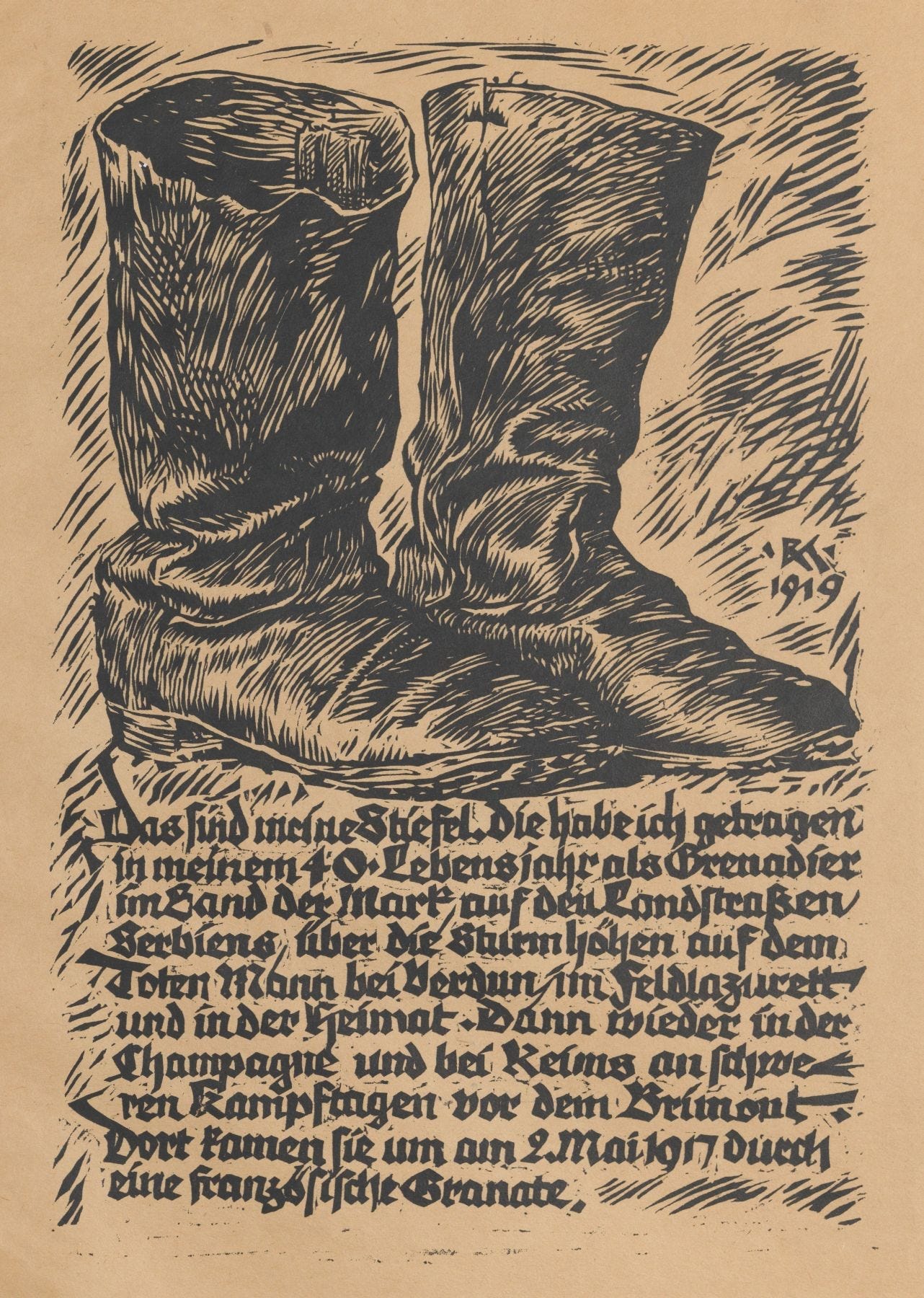
Text from the image above: “These are my boots. I wore them when I was 40 years old, while serving as a grenadier: in the sand of the Marque river, on the country roads of Serbia, in the assault on Dead Man’s Hill near Verdun, in the field hospital, and at home. I wore them again in the Champagne region and near Rheims during the heaving fighting in front of Brimont, where they were destroyed by a French shell on 2 May 1917”
Substack may force UK residents to log in to read this “violent” post. To avoid this inconvenience, I believe the easiest workaround is to follow via RSS:
https://blog.oboluspress.com/feed
I like the FeedFlow app. It works on desktops (including Linux), Android, and Apple.
The Obolus Press publishes the kind of books you won’t find anywhere else: works that have never been translated into English, literary and philosophical texts that have fallen out of print, and monographs about neglected European artists.
Recovering what mainstream publishing abandoned. We sell directly to readers, not through Amazon. Order at www.oboluspress.com
“The war is over. Germany is home now!”
Further can be used as a verb, farther cannot, as to further a cause, or to advance it. Further may also be used to mean 'additionally', as in 'furthermore'.
A ball may be thrown farther, but not further. That's English for you.
"'farther' is more appropriate than 'further' when describing physically measurable things." please tell me why?